

TL;DR: Speak to at least three agents before deciding. Compare performance data, not just fees. Avoid agents who overvalue your home to win your business. Check marketing quality — it directly affects your final price. Read the contract before you sign. A better agent almost always puts more money in your pocket than they cost.
What This Guide Covers
Choosing an estate agent is one of the most significant decisions involved in selling your home. The agent you select will shape how your property is presented, how buyers respond to it and ultimately what price you achieve. Yet most sellers spend more time researching their next holiday than they spend comparing the agents competing for their business.
At Ashcombe Estate Agents, we see what good agency looks like and we see what happens when sellers make the wrong choice.
Why the Right Agent Makes Such a Difference
It is easy to assume that estate agents do broadly the same job. In practice, the differences between agents — in their approach to pricing, marketing and negotiation — can translate directly into thousands of pounds on your final sale price.
One of our clients had previously listed their home with a national fixed-fee agent. They paid the fee upfront. Viewings were minimal and when enquiries did come through the agent called at short notice and asked them to conduct the viewings themselves. The property did not sell. They came to us, we marketed the property properly and it sold. The original fee was lost entirely.
This type of experience is more common than most sellers realise and it is almost always avoidable.
Start With a Shortlist of Local Agents
Before inviting anyone to value your home, spend time building a shortlist of agents who are genuinely active in your area. Look at which agents have For Sale boards on nearby properties. Check which ones regularly sell homes similar to yours in type, price range and location. Read Google reviews with care and ask friends or neighbours about their own experiences.
The best-known agent in your area is not always the right choice for your property. What matters is local presence, relevant track record and consistent performance in your specific market. Aim to shortlist at least three agents before taking the process any further.
Compare Performance Data
Most sellers compare fees. Far fewer compare the data that actually predicts their outcome.
When speaking to agents, ask how often they achieve asking price, how long their listings typically take to sell and what percentage of their properties complete. A professional agent should be pricing homes using Rightmove sold data, Land Registry records and live Rightmove market data available to property professionals. Combined with genuine knowledge of the local area, this produces a realistic valuation and a realistic valuation is what attracts serious buyers.
Any agent who is reluctant to share their performance data is telling you something important.
Get at Least Three Valuations
A single valuation gives you nothing to measure against. Inviting at least three agents to assess your home allows you to compare their reasoning, not just their numbers.
When each agent visits, ask them to justify their figure. Which comparable properties support it? How long are similar homes currently taking to sell? What is the current level of buyer demand for your property type?
Some agents inflate valuations to win instructions with the intention of recommending price reductions once they have your signature on a contract. An overpriced property does not attract more interest — it attracts less. Serious buyers know the market well and an inflated listing will often sit unsold while more realistically priced properties move around it. A valuation that reflects the market serves your interests. One that flatters you serves the agent’s.
Assess Marketing Quality Before You Commit
The majority of buyers now find properties on Rightmove, Zoopla and OnTheMarket before they ever speak to an agent. Your listing on those portals is the first impression your home makes on almost every prospective buyer.
Poor photography, weak descriptions and listings that look identical to dozens of others reduce viewings. Fewer viewings means less competition between buyers and less competition means lower offers.
We regularly take on properties that other agents listed without success. In most of those cases, marketing quality was the determining factor. Professional photography, drone footage and video walkthroughs require a real investment of time and resource — but that investment directly affects the number of viewings a property receives and whether it sells at all.
Before committing to any agent, look carefully at their live listings. Assess the quality of photography and the strength of the descriptions. Ask whether they produce video tours and whether your listing will benefit from featured or premium placement on Rightmove.
At Ashcombe Estate Agents, we pride ourselves on high quality marketing. If you are considering selling, contact us for a valuation.
Understand Fees, But Do Not Make Them Your Priority
UK estate agent fees typically sit between 0.9% and 3.6% including VAT, with most full-service agents charging around 1.2% to 1.4%. Fixed-fee agents offer a lower upfront cost but that model carries a fundamental limitation, the agent receives the same payment regardless of what your home sells for. Their financial interest and yours are not aligned.
A percentage-based agent earns more when you earn more. If a better agent charges £1,000 more in fees but achieves £10,000 more on your sale, your net return is still £9,000 higher. The question to focus on is not which agent costs least but which agent is most likely to put the most money in your pocket.
Read the Contract Carefully
Contract terms are where most sellers make their most expensive mistake and where most agents offer the least transparency.
Tie-in periods of 12 to 16 weeks are common but they carry real risk. A seller who lists in spring and signs a 12-week exclusivity agreement is locked in through the peak of the spring market and well into summer before they have the freedom to move to another agent. By that point, the most active buyers have often committed elsewhere.
Sole selling rights clauses mean you pay the agent’s fee even if you source your own buyer independently. Additional marketing costs are sometimes buried in the terms rather than presented upfront. Before signing anything, understand exactly what triggers your obligation to pay and under what circumstances you can exit the agreement.
A confident agent with a strong local track record will not need to lock you in for three months to keep your business.
Questions to Ask Every Estate Agent
These are the questions that separate a well-prepared seller from one who regrets their choice six weeks later.
- What percentage of your listings sell at or above asking price?
- How long are your current listings taking to sell on average?
- Do you have registered buyers who match my property right now?
- Who conducts viewings — a member of your team or the vendor?
- What does your photography and marketing process involve?
- How will you update me and how often?
- What is your minimum contract term?
- What happens if I am no satisfied with your service?
Ask each agent the same questions and compare the answers directly. Vague responses, deflection or reluctance to commit to specifics are all worth noting.
One test worth carrying out: ask the agent to reduce their fee. If they agree quickly and without resistance, consider how they will approach negotiating your sale price when a buyer pushes back on your asking price. A good negotiator understands the value of what they are selling. Their own fee is the first demonstration of that.
The Market in 2026
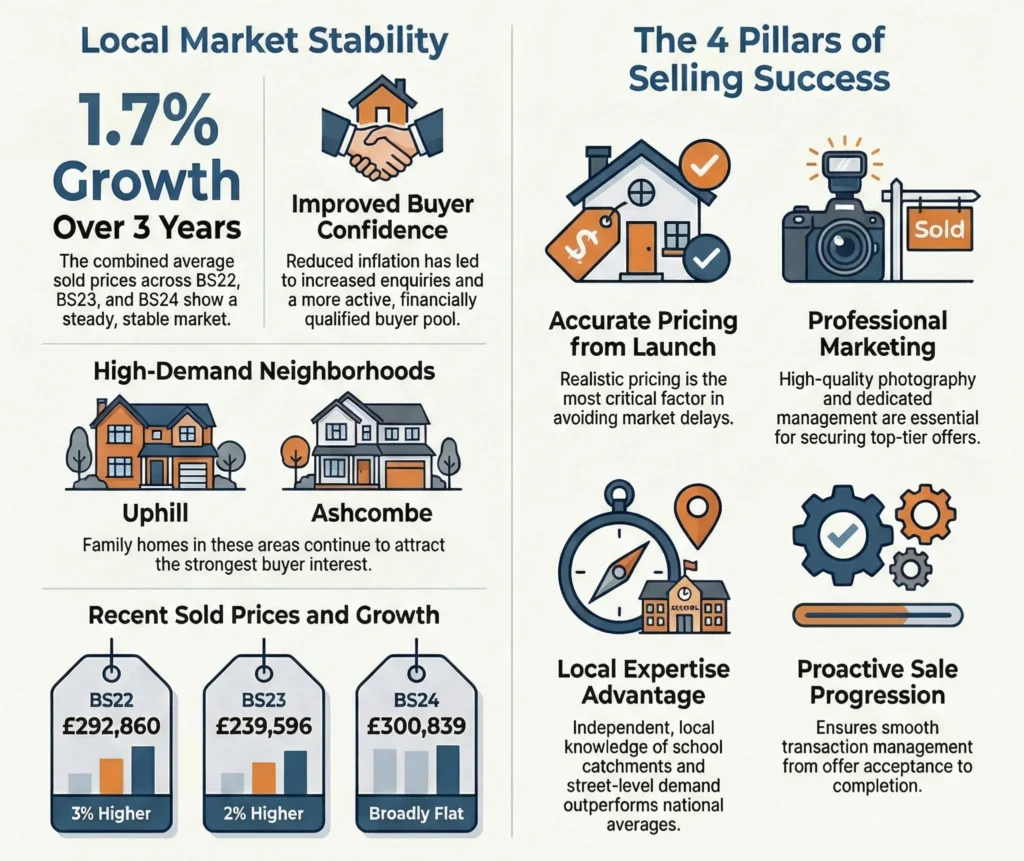
The current market rewards sellers who prepare and price their homes correctly. Buyer confidence has been affected by ongoing global uncertainty, the possibility of further interest rate movement and concerns about the pace of economic growth. Buyers are making considered decisions rather than reactive ones.
The opportunity for sellers lies in what follows from this. Housing stock remains limited and buyers who are active in the market are competing for a smaller number of well-presented, realistically priced properties. A home that is professionally marketed and sensibly valued draws stronger interest in this environment than many sellers expect.
Choosing the right agent matters more in a market like this, not less.
Trust Your Judgement Alongside the Data
After the valuations, the performance comparisons, the contract reviews and the questions, a final consideration remains.
The agent you appoint will represent your home to buyers, manage your viewings and negotiate your sale. The relationship requires trust, clear communication and the confidence that the agent is genuinely invested in your outcome. Use the data to eliminate poor performers. Use your judgement to select the right one from those who remain.
What the Best Estate Agents Have in Common
The best agents share certain characteristics regardless of size or location. They have a demonstrable local track record supported by data. They produce marketing that reflects the quality of the homes they sell. They consistently achieve close to asking price. They communicate proactively and honestly. And they do not need lengthy tie-in periods to retain your confidence.
Final Summary
Choosing the right estate agent comes down to five things.
- Build a genuine shortlist. Speak to at least three local agents with a relevant track record before making any decision.
- Focus on performance over price. An agent who achieves more on your sale will almost always cost you less overall than a cheaper agent who undersells your home.
- Take marketing seriously. The quality of your photography, listing copy and portal presence directly determines how many buyers view your property and what they are prepared to offer.
- Read every line of the contract. Tie-in periods, sole selling rights clauses and buried marketing costs have cost sellers thousands. Understand what you are signing before you sign it.
- Choose the agent you trust. Information helps you to narrow down to a select few agents, trust your own judgement to make a final decision.
The difference between an average agent and the right one is measurable in tens of thousands of pounds. The time spent choosing carefully is time well spent.
FAQ’s
Speaking to at least three agents gives you a meaningful basis for comparison across valuations, fees, marketing approach and contract terms.
Most full-service agents charge between 1.2% and 1.4% including VAT. Fixed-fee agents charge less upfront but typically offer a more limited service and have no financial incentive tied to your final sale price.
Not on that basis alone. Some agents inflate valuations to win instructions with the intention of reducing the price later. An overpriced property typically generates fewer viewings and weaker offers.
In most cases, yes. If a better agent achieves £10,000 more on your sale and charges £1,000 more in fees, your net gain is still £9,000.
Pay close attention to tie-in periods, sole selling rights clauses and any marketing costs not included in the headline fee. Understand the minimum contract term and the conditions under which you can exit.